Meme coin trading can turn a small bankroll into six figures when you treat it as a risk budget rather than a lottery ticket
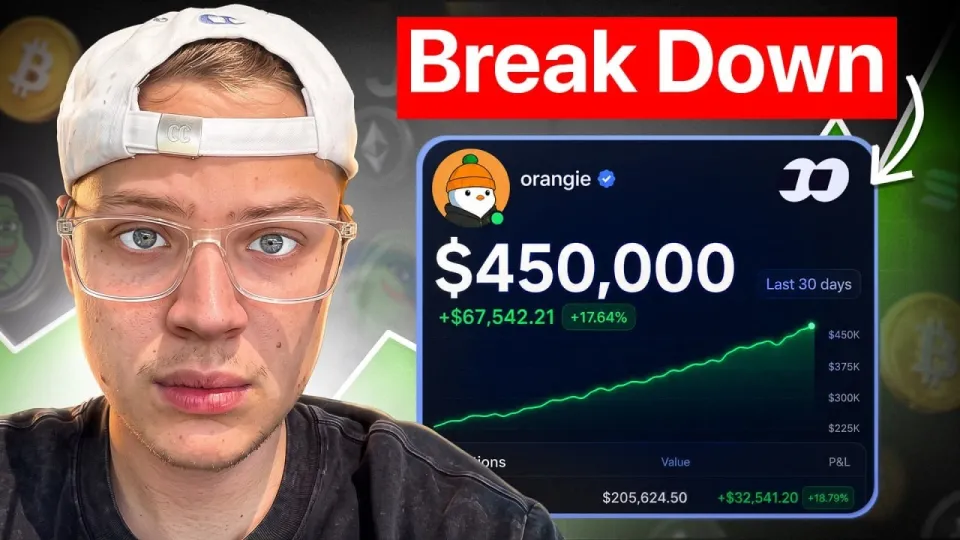
Video: How I Made $450,000 Trading Memecoins in 30 Days
Need articles like this for your video? They help promote it on YouTube and Google — order them in the Telegram bot @sat_sit_bot. The bot writes and publishes the articles itself (with your YouTube video embedded) on popular topical websites (no ads). Free trial — 50 articles.
· based on the channel Orangie Web3
Key takeaways
- Orangie Web3 reports turning $450,000 in 30 days trading memecoins, mostly on Solana.
- The strategy is built on many small losing bets and a few outsized winners, not on one perfect call.
- Most memecoin traders lose money; position sizing matters more than picking the next 100x.
- Access to fast execution and early liquidity (FOMO, sniper tools) shapes outcomes more than chart reading.
- Private calls and copy-trading groups are a structural advantage retail traders rarely replicate.
A meme coin is a cryptocurrency with no cash flow, no product and no roadmap that survives purely on attention, and trading it profitably means treating every buy as a lottery ticket with a fixed price rather than an investment. The most-cited recent example is Orangie Web3's breakdown of a $450,000 run in 30 days, where the edge came from position sizing and speed, not from predicting which token would pump. If you want the same toolkit the channel uses, the Kaizen Group access link is where the paid community and trade calls live.
What a meme coin actually is and why it moves so fast
A meme coin is a token whose price is driven almost entirely by social attention, liquidity and the order flow of a small number of wallets. There is no earnings report to anchor a valuation, so the price is whatever the next buyer will pay in the next five minutes. That is why a token can go from a $40,000 market cap to $4 million and back to $60,000 inside a single afternoon.
The mechanics matter more than the meme. On Solana, a token typically launches through a bonding curve on a launchpad, graduates to a decentralized exchange once it hits a liquidity threshold, and then lives or dies on trading volume. Graduation is not a quality stamp; it is just a liquidity event. Most tokens that graduate still bleed to zero within days.
Three structural features explain the speed:
- Liquidity is thin. A few thousand dollars of sell orders can wipe 60% off a small-cap memecoin.
- Supply is concentrated. A handful of wallets often hold enough to dump on retail at any moment.
- Attention is reflexive. Price movement itself generates the posts, clips and mentions that bring the next wave of buyers.
The $450,000 claim and what it does and does not tell you
A $450,000 result in 30 days is a real outcome reported by the channel, but it is a single sample from a strategy with enormous variance. The honest framing is that such a number usually comes from a small number of very large winners sitting on top of dozens of small losses, plus the ability to size up aggressively when a position is already working.
What the result does not tell you is the drawdown. Traders who post gains rarely post the weeks where a bankroll halved. It also does not tell you how much of the edge came from being early to calls in a private group. One of the most-liked comments under the video makes exactly this point: the trader is in a Discord with other active traders who flag coins to each other and act on the same information within seconds. That is a structural advantage, not a chart pattern you can learn from a screenshot.
Treat the number as a demonstration of what aggressive sizing can do in a hot market, not as a baseline expectation. The same sizing that produces a six-figure month produces a wiped account in a cold one.
Position sizing rules that keep a meme coin bankroll alive
Surviving long enough to catch one large winner is the entire game, and that is a sizing problem before it is a picking problem. The practical rule is to define a total risk budget you can lose completely without changing your life, then split it into small, equal-sized bets.
A workable framework looks like this:
- Set a total bankroll for memecoins that is separate from savings and long-term holdings.
- Cap any single entry at 1–3% of that bankroll. If a token goes to zero, you lose that slice and nothing more.
- Take initial capital off the table once a position doubles or triples, then let the remainder run.
- Never add to a losing position. Averaging down on a token with no fundamentals is how small losses become total ones.
- Keep a written log of entry, exit and the reason for each trade so you can tell luck from skill after 50 trades.
One viewer described losing roughly 90% of a $100 stake while learning the mechanics, then recovering it with a single 3x on a token. That is exactly how the distribution works: many small losses, occasional multiples. The traders who fail are the ones who size every bet as if it is the big one.
Entry and exit logic on Solana memecoins
Execution speed and liquidity checks decide more outcomes than narrative does. Before buying anything, verify that liquidity is locked or burned, that the top holders are not a single cluster, and that trading volume is coming from many wallets rather than two. On Solana this takes seconds with a holder checker and a launchpad page.
A simple, repeatable process:
- Screen for tokens with rising unique holder counts, not just rising price.
- Check the contract for mint authority and freeze authority; if either is still active, skip it.
- Enter small on the first consolidation after launch rather than chasing the vertical candle.
- Set a mental invalidation level before entry and exit mechanically if it breaks.
- Scale out in tranches on the way up instead of trying to sell the exact top.
Platforms such as the FOMO trading platform bundle charting, wallet tracking and fast execution into one interface, which matters because on memecoins a thirty-second delay is often the difference between a 4x and a bag you cannot exit.
Typical questions traders raise after watching a six-figure month
The recurring doubts in the comments are less about which coin to buy and more about whether the whole thing is replicable. Several viewers ask how much of the result came from private coordination, others ask whether they are too slow to follow along, and beginners ask whether a small account can even participate.
On coordination: yes, being in an active group with traders who share calls is a genuine edge, and pretending otherwise is dishonest. You can partially close that gap by joining communities, but you cannot fully replicate a group that has been trading together for months.
On speed: the videos are dense and fast, which many viewers flag as both a strength and a barrier. The fix is to pause and replay specific trades rather than watching straight through, and to write down the entry and exit logic for each example.
On small accounts: a $100 account can learn the mechanics, but it cannot absorb the fees and slippage of frequent trading. Build the habit on tiny size, then scale only after you have a documented process.
Useful links
- Kaizen Group access and trade calls: https://whop.com/checkout/plan_GTFkEFh0JFpU8?a=orangie
- FOMO trading platform: https://fomo.family/r/orangie
- Orangie Discord community: https://discord.gg/memecoins
- Instagram: https://www.instagram.com/orangieyt/
Final takeaway
The meme coin market rewards disciplined risk budgets and fast execution far more than it rewards conviction, and the $450,000 month is best read as evidence of what aggressive sizing can do in a hot cycle rather than a target to chase. Anyone entering this market should assume most positions go to zero, size accordingly, and treat every winner as a chance to recover capital rather than a reason to double down. This breakdown draws on the analysis published by the Orangie Web3 channel, which covers Solana memecoin trading and community tools in detail. If you want the same calls and workflow, start with the Kaizen Group checkout and paper-trade the process before committing real size.
Source: How I Made $450,000 Trading Memecoins in 30 Days · Markdown version
Questions & answers
Is it realistic to make $450,000 trading meme coins in 30 days?
It is possible in a hot market with aggressive sizing and a few large winners, but it is an outlier outcome, not an expectation. Most traders lose money, and the same sizing that produces a six-figure month can wipe an account in a cold market.
How much of the result comes from private groups and shared calls?
A meaningful share. Being in an active community where traders flag coins to each other within seconds is a real structural advantage that a solo trader watching public charts cannot fully replicate.
What is the minimum I need to start trading meme coins?
You can learn the mechanics with $50–$100, but fees and slippage eat a large share of frequent small trades. Treat a small account as tuition for building a documented process, then scale only after the process works.
How do I avoid losing everything on a single token?
Cap each position at 1–3% of a dedicated bankroll, never add to a losing trade, and pull initial capital out once a position doubles or triples. Assume any individual token can go to zero and size so that outcome is survivable.