Forex Trading for Beginners Without the Noise
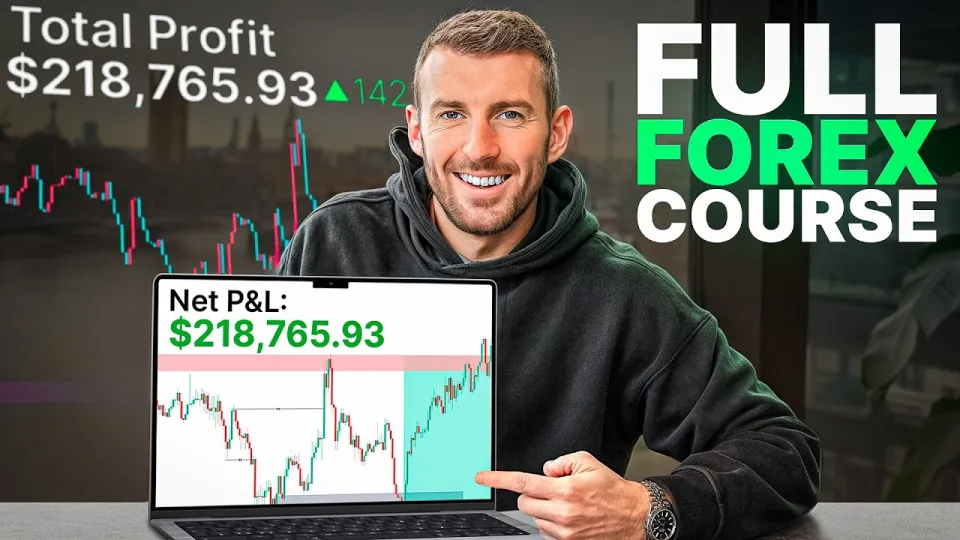
Video: Beginners Guide To Forex Trading In 2026 (+3 hours)
Need articles like this for your video? They help promote it on YouTube and Google — order them in the Telegram bot @sat_sit_bot. The bot writes and publishes the articles itself (with your YouTube video embedded) on popular topical websites (no ads). Free trial — 50 articles.
· based on the channel Matt Donlevey - Photon Trading
Key takeaways
- Forex is an over-the-counter market where currencies are quoted in pairs; the price you see is the spread between bid and ask, and that spread is a real cost on every trade.
- Technical patterns alone do not explain price movement; order flow, auction market theory and liquidity are the mechanics behind the charts.
- Structure comes in three forms — trend, range and transition — and premium/discount positioning helps decide where a trade is worth taking.
- Risk control comes before psychology: position size, stop placement and a written trade plan decide survival, not motivation.
- A broker choice is a cost decision: spread, commission, slippage and execution quality matter more than bonus offers.
Forex is the market where national currencies are traded against each other in pairs, and beginners should treat it as a business of probabilities rather than a place to get rich quickly. The price you see on a chart is the result of bids and offers from banks, funds, brokers and retail traders meeting in an over-the-counter network, not on a single exchange. A free structured starting point — the Photon Trading course and cheatsheets from Matt Donlevey - Photon Trading — is available at the free training page.
What forex actually is and who moves the price
Forex is a decentralized market: there is no central exchange setting one official price, so quotes differ slightly between liquidity providers and brokers. Currencies trade in pairs — EUR/USD, GBP/USD, USD/JPY — where the first currency is the base and the second is the quote, and the quoted number tells you how much of the quote currency one unit of the base costs.
The participants fall into a few layers:
- Central banks and large commercial banks, which set the interbank flow.
- Hedge funds, corporates and prop firms, which add volume around news and hedging needs.
- Brokers and liquidity providers, which aggregate quotes and pass them to retail platforms.
- Retail traders, whose orders are small individually but visible in aggregate through price behavior.
Because the market is decentralized, the price you can buy at and the price you can sell at are never identical. That difference is the spread, and it is the first cost every beginner must understand before thinking about profit.
Market microstructure: bid, ask, spread and the order book
Market microstructure is the study of how orders become prices, and it explains why a trade can be filled worse than expected. The bid is the highest price a buyer is currently willing to pay; the ask is the lowest price a seller will accept; the spread is the gap between them. If EUR/USD quotes 1.0850 bid and 1.0851 ask, the spread is one pip, and a position opened and closed instantly loses that pip.
The order book shows resting orders at different prices. Liquidity is not evenly distributed: clusters of stop losses and pending orders sit above highs and below lows, and price often accelerates toward those zones because that is where fills are available. Auction market theory frames this as a search for fair value — price moves up and down to find a level where buyers and sellers agree to transact, then leaves when one side becomes aggressive.
Order flow is the practical conclusion: instead of asking what shape a chart makes, ask who is forced to act next. A breakout above a high with no follow-through often means there was no real buying, only stop triggering. That distinction is what separates a strategy built on market logic from pattern drawing.
How much can a forex trader realistically make
Returns in forex depend on three variables: the edge per trade, the number of trades and the size of the risk taken, so any single income figure quoted without those details is marketing. A trader risking 0.5% per trade with a 1:2 reward-to-risk ratio and a 45% win rate earns a positive expectancy, but the account grows slowly and unevenly.
Realistic expectations look like this:
- A consistent retail trader targeting 2–5% per month on a funded or personal account is already performing well.
- Drawdowns of 10–20% happen even to profitable systems, because losing streaks are normal.
- Leverage amplifies both directions; 1:100 leverage does not mean you should use it.
- Prop firm funding changes the math — a payout split of 80–90% on a funded account can exceed personal capital returns, but the evaluation rules on drawdown are strict.
Anyone promising a fixed monthly percentage is selling a narrative, not a system. The honest answer is that profitability is possible but depends on execution discipline, cost control and sample size.
Market structure, premium and discount, and multi-timeframe context
Market structure is the sequence of highs and lows that tells you whether buyers or sellers currently control the auction. Three types cover almost every chart: trending structure (higher highs and higher lows, or the inverse), ranging structure (price oscillating between a ceiling and a floor), and transition structure (a break that has not yet produced a new trend).
Premium and discount add positioning: within a defined range, the upper part is premium and the lower part is discount. Buying in discount and selling in premium improves the reward-to-risk of a trade compared with chasing price in the middle of the range.
Multi-timeframe analysis connects the two ideas. A trader checks the higher timeframe for direction and the relevant zone, then drops to a lower timeframe for confirmation and entry. Supply and demand zones mark areas where aggressive buying or selling previously appeared, and liquidity concepts explain why price often sweeps beyond an obvious high or low before reversing — that sweep is where resting orders get filled.
Entries, trade management and money management
A trade entry is the last step, not the first, because the setup must already have context from structure, zone and liquidity. A workable sequence:
- Identify the higher-timeframe direction and the zone where you would be interested.
- Wait for price to reach that zone and show a reaction on the lower timeframe.
- Enter with a stop beyond the level that would invalidate the idea.
- Set a target at the next liquidity pool or opposing zone, and define partial exits in advance.
- Move to break-even only according to a rule, not according to emotion.
Money management decides survival. Risking a fixed small percentage per trade, capping total open risk and reducing size after a losing streak keeps a normal drawdown from becoming a terminal one. Trade management is where most beginners improvise, and improvisation is what turns a positive-expectancy plan into a negative result.
Common mistakes, trade plans and journaling
The three mistakes that recur most often are oversized risk, trading without a written plan and abandoning the plan after a few losses. A trade plan should state the markets traded, the sessions, the setup criteria, the risk per trade, the maximum daily loss and the conditions under which no trade is taken.
Backtesting turns that plan into evidence. Testing a strategy over a few hundred historical setups gives a rough win rate and drawdown profile, which is far more useful than a handful of screenshots. Journaling then tracks live execution: entry reason, screenshot, result, emotional state and deviation from plan. Over time the journal shows whether losses came from the market or from the trader.
Costs deserve the same attention. Spread, commission, swap on positions held overnight and slippage all reduce expectancy, so a strategy that looks profitable before costs can be flat after them. When choosing a broker, compare regulation, execution model, average spread on your instruments and withdrawal terms rather than deposit bonuses.
Typical beginner questions answered
Many viewers of long-form courses arrive with the same doubts: whether three hours of material is too much, whether technical analysis is worthless, and whether psychology should be studied first. The practical answer is that the material is long because the market is layered, that technical analysis works only when it is tied to order flow and liquidity, and that psychology becomes the bottleneck after a strategy has a proven edge — not before.
Another recurring concern is speed and language. A dense course rewards pausing, note-taking and re-watching specific sections rather than passive viewing, and the timestamps in the original video exist exactly for that. The most common self-reported mistake is jumping between strategies before testing any single one properly.
Useful links
- Free Photon Trading course and cheatsheets
- Photon Trading mentorship
- Free Telegram channel with analysis and trade recaps
- Photon Trading on Instagram
Final thoughts
Forex rewards traders who understand mechanics before patterns: spread and order flow explain the chart, structure and liquidity explain the setup, and risk control explains who is still trading a year later. The full three-hour walkthrough by Matt Donlevey - Photon Trading is a strong reference because it connects microstructure, strategy development, backtesting and psychology into one sequence instead of scattered tips. Start with the free course material, write a plan, test it on historical data and journal every execution. If you want the structured version with cheatsheets, begin at the free training page.
Source: Beginners Guide To Forex Trading In 2026 (+3 hours) · Markdown version
Questions & answers
Is forex trading suitable for a complete beginner?
Yes, but only as a skill to be learned slowly. Beginners should start with a demo account, a single currency pair, small risk per trade and a written plan, because the main early losses come from oversized positions and untested ideas rather than from lack of information.
How long does it take to become consistently profitable in forex?
Most traders need at least one to two years of deliberate practice, including backtesting and journaling, before results stabilize. Progress depends on the number of properly reviewed trades and on whether the trader follows rules, not on how many videos were watched.
Do I need technical analysis to trade forex?
Technical analysis is useful as a language for describing price, but patterns alone do not explain movement. It works best when combined with market microstructure, order flow and liquidity, which show where orders actually sit and why price reacts at certain levels.
How much capital do I need to start trading forex?
You can open an account with a few hundred dollars, but the meaningful question is position sizing relative to risk. Trading micro lots with 0.5% risk per trade requires far less capital than most people assume, while trading too large for the account is the fastest way to lose it.